Children learn social skills through everyday interactions with parents, siblings, teachers and peers. They gradually learn how to greet someone, join a conversation, take turns, share, understand another person’s perspective, respond appropriately and manage disagreements. For some children, these skills develop naturally. Others may need more structured opportunities to understand social expectations and practise how to respond in different situations. Difficulty with social interaction does not always mean that a child lacks interest in other people. A child may want to make friends but struggle to understand how to enter a game, maintain a conversation or respond when another child changes the activity. Another child may communicate well with adults but find peer interaction difficult because social situations are less predictable.
Social skills therapy for children provides structured opportunities to learn and practise these skills in a way that matches the child’s developmental level. It can be useful for children who experience difficulties with social communication, peer interaction, conversational skills, emotional understanding, flexibility or participation in group settings. The objective is not to make children behave in one particular way. It is to give them practical tools that help them understand social situations, communicate their needs and participate more comfortably and effectively with others.
1. What Are Social Skills?
Social skills are the behaviours and communication abilities people use to interact with others. They include both verbal and non-verbal behaviours. A child uses social skills when they greet someone, listen to another person, respond to a question, wait for a turn, share an activity, ask for help, recognise that someone is upset or adjust their behaviour according to the situation. These abilities develop gradually and become more complex with age. Younger children may initially need support with sharing and turn-taking, while older children may need to understand humour, perspective-taking, conversational boundaries, conflict resolution or friendship dynamics. Social development is therefore not a single skill that can be taught in one session. It involves several related abilities that need to be practised across different situations.
2. What Is Social Skills Therapy for Children?
Social skills therapy for children is a structured approach that helps children understand, develop and practise specific social behaviours. The skills targeted depend on the child’s age, communication abilities, existing strengths and areas of difficulty. Therapy may address how a child starts an interaction, responds to another person, maintains a conversation, participates in a shared activity or manages a disagreement. It can also focus on understanding facial expressions, body language, tone of voice and other social information. At Asha Hai, social communication and behaviour therapy is designed to help children understand how to relate to and play with other children and learn appropriate behaviours for different situations. Our therapists use methods such as play, role-playing and visual materials according to the child’s needs.
3. Who May Benefit From Social Skills Therapy?
Children may benefit from social skills therapy when social difficulties consistently affect their relationships, participation or functioning at home or school. This can include children who find it difficult to initiate or maintain interactions, understand social expectations, participate in group activities, respond appropriately to peers, manage changes during play or interpret social cues. Social skills support may be relevant for children with social communication difficulties, autism, ADHD, developmental differences, learning difficulties or other conditions affecting social participation. It can also be considered for children who do not have a specific diagnosis but have persistent difficulties forming or maintaining peer relationships. The decision to begin therapy should be based on the child’s actual needs rather than a diagnosis alone.
4. Skills That Social Communication Therapy Can Develop
A. Starting an Interaction
Starting an interaction requires a child to notice another person, decide what they want to communicate and choose an appropriate way to begin. Some children may stand near a group without knowing how to join, while others may interrupt or approach without recognising whether the other child is available. Social communication therapy can provide structured practice in simple ways of initiating interaction, such as greeting someone, asking to join a game, commenting on an activity or asking a relevant question. Repeated practice helps children understand that the appropriate approach can change depending on the situation and person.
B. Responding to Others
Social interaction depends on responding, not simply initiating. A child may ask a question but struggle to listen to the answer or may change the subject without responding to what another person has said. Social skills therapy for children can work on responding to questions, comments, requests and social cues. Activities can help children recognise when a response is expected and practise responses that are relevant to the interaction.
C. Turn-Taking
Turn-taking is fundamental to conversations and shared activities. Children need to wait, recognise when another person’s turn has ended and understand when it is appropriate to participate. This skill can be developed through structured games, conversations and play activities. At Asha Hai, turn-taking and waiting are incorporated into play and language activities where appropriate, giving children opportunities to practise these skills within meaningful interactions.
D. Sharing and Cooperative Play
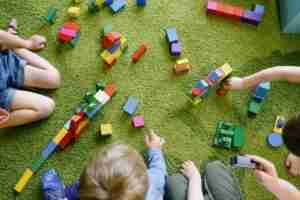
Playing with another child requires more than knowing how to use a toy. Children need to share materials, follow agreed rules, accept another person’s ideas and adjust their actions when the activity changes. A child who prefers solitary or highly predictable play may need additional opportunities to participate in cooperative activities. Social communication therapy can use games and shared play to gradually build cooperation, flexibility and reciprocal interaction.
E. Maintaining a Conversation
A conversation involves listening, responding, taking turns, staying on topic and recognising when the interaction should end or change direction. Some children may talk extensively about their preferred interests without noticing whether the other person is engaged. Others may answer questions but have difficulty adding information or asking questions in return. Therapy can break conversational skills into manageable steps and provide repeated opportunities to practise them. The aim is to develop genuine back-and-forth communication rather than simply teaching children a fixed set of phrases.
F. Understanding Non-Verbal Communication
People communicate through more than words. Facial expressions, gestures, body position, eye gaze, tone and physical distance can all provide information about what someone means or feels. Children may not automatically interpret these signals in the same way as their peers. Social skills therapy for children can use pictures, videos, role-play and real-life examples to help children notice and interpret relevant social information. The objective is not to require a particular form of eye contact or facial expression. It is to help children understand and respond to the information that other people communicate.
G. Recognising Emotions
Understanding emotions is closely connected to social interaction. Children need to recognise their own feelings as well as notice signs that another person may be happy, disappointed, frustrated, worried or upset. Therapy can use stories, pictures, role-play and everyday situations to help children connect situations with emotions and consider appropriate responses. This can support more effective communication when children encounter unfamiliar or challenging social situations.
H. Understanding Personal Space and Social Boundaries
Children gradually learn that different situations have different social expectations. The appropriate distance, volume, topic and behaviour can change depending on whether they are speaking to a friend, teacher, family member or unfamiliar person. Social communication therapy can help children understand these differences through concrete examples and guided practice. The goal is to make social expectations easier to recognise and apply rather than relying on abstract instructions such as “behave properly.”
I. Handling Disagreements
Disagreements are a normal part of relationships. Children need to learn how to express disagreement, listen to another person’s view, negotiate and seek help when necessary. A child who becomes overwhelmed during disagreements may need explicit practice with alternative responses. Role-play can provide a safe environment to rehearse situations such as losing a game, having a toy taken, disagreeing about rules or being told “no.” These skills become more useful when children are later able to apply them during genuine peer interactions.
J. Adapting to Changes in Play
Social situations rarely follow a completely predictable script. Another child may change the rules, introduce a different game, leave the activity or suggest an unfamiliar idea. Flexibility can therefore be an important part of social development. Social skills therapy for children can introduce controlled changes during activities and help children practise adjusting their responses without abandoning the interaction. The level of challenge should be appropriate for the child. The purpose is gradual learning, not deliberately creating distress.
5. Why Practice With Other Children Matters
Social skills cannot be fully developed through instruction alone. A child may be able to explain what they should do during a conversation but still struggle to use the skill when interacting with a peer. This is why opportunities for real interaction are important. A social skills group for children can provide a structured environment where children practise skills with peers rather than only with adults. Group activities can create opportunities to practise waiting, sharing, initiating interaction, responding to others, following group rules and adjusting to different communication styles. The therapist can observe the interaction and provide support when necessary. A group should be structured around the children’s developmental needs. Simply placing children together does not automatically create effective social learning.
6. What Happens in a Social Skills Group for Children?
A social skills group for children typically uses structured activities to create opportunities for interaction. Depending on the children’s ages and goals, sessions may include cooperative games, role-play, conversation activities, social stories, group problem-solving or guided play. At Asha Hai, social skills are taught by breaking expectations into manageable steps, explaining them using concrete or visual methods and providing opportunities for children to practise newly learned skills. The therapist’s role is not simply to supervise the group. The therapist observes how children interact, identifies where support is required and helps children apply appropriate strategies within the activity.
7. Why Role-Playing Can Be Useful
Role-playing allows children to practise situations before encountering them in everyday life. A therapist can create scenarios involving joining a game, asking for help, meeting someone new, handling disagreement or responding when another person says no. The child can practise a response, receive feedback and try again. This is different from simply telling a child what they should do because it provides an opportunity to rehearse the behaviour. Asha Hai uses role-playing as one of its methods within Social Communication and Behaviour Therapy to help children understand expected behaviours and prepare for future interactions.
8. Using Visual Supports
Some social situations are difficult because expectations are not obvious. Visual supports can make abstract social information more concrete. Social stories, pictures, visual sequences and other materials can show what happens before, during and after a particular situation. For example, a visual sequence can demonstrate how to enter a group activity or what steps are involved in asking another child to play. Visual supports should be used according to the child’s needs and should gradually support greater independence rather than becoming the only way a child can manage a situation.
9. Building Confidence Through Social Competence
Confidence does not come simply from telling a child to “be confident.” It can develop when children gain practical skills and experience successful interactions. A child who previously did not know how to enter a game may become more willing to approach peers after practising that skill. A child who frequently became frustrated during disagreements may become more confident when they learn alternative ways to communicate. The purpose of social skills therapy for children is therefore not to change a child’s personality. It is to give children greater control over how they communicate and participate in social situations.
10. Social Skills at School
School provides frequent opportunities for social interaction. Children need to work with classmates, participate in group activities, follow classroom expectations, communicate with teachers and navigate peer relationships. For some children, social difficulties may become more noticeable in school because the number and complexity of interactions increase. Asha Hai also provides school-based support focused on communication, social interaction, emotional regulation and learning readiness. Our programmes work with schools and families to help children participate more meaningfully in classroom environments and peer interactions. Social goals are more useful when they can be applied across settings rather than only during therapy sessions.
11. The Role of Parents
Parents provide some of the most frequent opportunities for children to practise social communication. Everyday activities such as playing a board game, preparing a meal together, visiting relatives or talking about the day can create opportunities to practise social skills. At Asha Hai, parent collaboration is an important part of our approach. We hold regular parent meetings to discuss goals, share feedback, review home-based plans and provide parent psychoeducation. The aim is not for parents to conduct therapy at home. Instead, parents can reinforce skills naturally during ordinary interactions so that children have opportunities to use them outside structured sessions.
12. How Progress in Social Skills Can Be Measured
Social development should be monitored through observable behaviour rather than vague statements such as “better social skills.” Depending on the child’s goals, progress may involve initiating an interaction more independently, responding appropriately to a peer, waiting for a turn, staying engaged in a shared activity, using a learned strategy during disagreement or participating in a group with less adult support. Progress should also be considered across different environments. A child may demonstrate a skill with a therapist but need additional support to use it with classmates. Regular observation helps identify whether a skill is becoming functional and generalised.
13. Choosing Social Skills Therapy for Children
When choosing social skills therapy for children, parents should look for a programme that identifies specific social goals rather than offering generic interaction activities. Ask how the child’s social communication will be understood, which skills will be targeted, how peer practice will be incorporated and how progress will be monitored. It is also important to understand how therapists involve parents and whether skills are supported across home and school environments. A good programme should be individualised. Children should not be expected to work on the same social goals simply because they attend the same group.
14. Social Skills Therapy at Asha Hai
At Asha Hai, we provide Social Communication and Behaviour Therapy in Hauz Khas, South Delhi, for children who need support with social interaction, communication and behaviour. Our approach uses structured teaching, visual materials, play and role-playing according to the child’s individual needs. Our wider programmes also support communication, learning, emotional regulation and participation in school and everyday environments. Where appropriate, our team works collaboratively across services so that social goals are connected to the child’s broader developmental needs. We focus on practical skills that children can use beyond the therapy setting, with parent involvement and regular review of goals forming an important part of the process.
15. Helping Children Connect With Others
Social development is built through repeated experiences of communicating, playing, negotiating, listening and responding. Some children acquire these skills naturally, while others benefit from explicit teaching and structured practice. Social skills therapy for children can provide a clear framework for developing skills such as initiating interaction, maintaining conversations, taking turns, understanding social cues and managing everyday peer situations. A social skills group for children can add valuable opportunities to practise these abilities with other children, while social communication therapy can address more specific communication and interaction needs. At Asha Hai, we take an individualised approach to social communication and behaviour support. We use play, role-playing, visual strategies and structured practice based on each child’s needs, while working with parents to help children apply developing skills beyond therapy sessions. The goal is not simply for a child to know what to do in a social situation. It is to help them understand, communicate, participate and build meaningful connections with greater independence and confidence.