Children develop at different rates, but certain behaviours may indicate a need for additional developmental support. A child who frequently loses concentration, struggles to follow instructions, finds social interactions difficult or becomes distressed when routines change may be experiencing characteristics associated with Attention-Deficit/Hyperactivity Disorder (ADHD) or Autism Spectrum Disorder (ASD).
Since both conditions can affect a child’s behaviour, communication and learning, parents often find it difficult to distinguish between them. However, ADHD primarily affects attention regulation, activity levels and impulse control, whereas autism involves differences in social communication, interaction and patterns of behaviour.
Understanding these differences can help parents recognise developmental concerns early and seek appropriate support. At Asha Hai, children receive individualised support through Autism and ADHD Therapy with interventions planned according to their developmental needs and abilities.
1. What Is ADHD in Children?
Attention-Deficit/Hyperactivity Disorder (ADHD) is a neurodevelopmental condition that affects a child’s ability to regulate attention, control impulses and manage activity levels. Children with ADHD may find it difficult to concentrate during lessons, complete homework, follow instructions or wait for their turn.
ADHD generally presents in three ways:
- Inattentive Presentation: The child may frequently forget instructions, lose belongings, make careless mistakes, daydream or leave tasks unfinished.
- Hyperactive-Impulsive Presentation: The child may constantly move, interrupt conversations, talk excessively or struggle to sit through activities.
- Combined Presentation: The child experiences difficulties with both attention and hyperactivity or impulsivity.
For example, a child may understand a homework assignment but repeatedly get distracted, leave the table and forget what they were doing. These difficulties are not necessarily caused by a lack of interest or motivation.
2. What Is Autism in Children?
Autism Spectrum Disorder (ASD) is a neurodevelopmental condition that affects social communication, interaction, behaviour and sensory processing. Autistic children may communicate, play, learn and respond to their surroundings differently.
Common characteristics include:
- Social Communication Differences: Difficulty understanding facial expressions, body language, conversational turn-taking or unspoken social rules.
- Repetitive Behaviours: Repeating particular movements, arranging toys in specific patterns or repeating words and phrases.
- Preference for Routines: Becoming distressed when familiar activities change or when unexpected situations occur.
- Sensory Sensitivities: Finding certain sounds, lights, clothing materials, food textures or crowded environments uncomfortable.
For instance, a child may cover their ears during loud noises, become upset when the usual school routine changes or prefer playing with toys in a particular way. Autism is a spectrum, meaning every child has a different combination of strengths, abilities and support needs. Autism Therapy in Delhi at Asha Hai focuses on addressing these individual needs through appropriate developmental and therapeutic interventions.
3. ADHD vs Autism: What Are the Key Differences?
Although ADHD and autism share some characteristics, the underlying reasons for a child’s behaviour may be different.
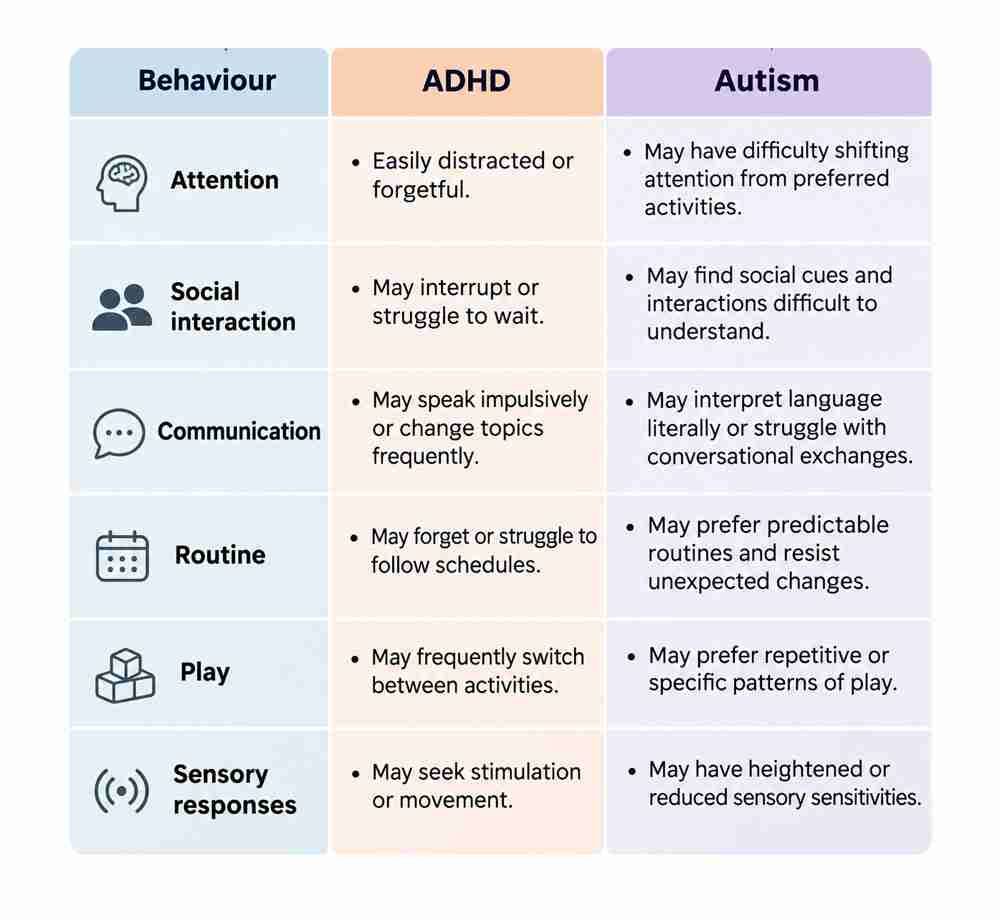
- Attention and Concentration: A child with ADHD may start several activities but struggle to complete them because of frequent distractions. An autistic child may concentrate deeply on a preferred activity but find it difficult to transition to something else. However, attention difficulties can occur in both conditions.
- Social Interaction: A child with ADHD may interrupt games, speak out of turn or struggle to wait because of impulsivity. An autistic child may find it difficult to understand how to join a group activity, interpret social cues or maintain a back-and-forth conversation. Both may experience friendship difficulties, but for different reasons.
- Communication: Children with ADHD may talk excessively, interrupt others or lose track of conversations. Autistic children may experience difficulties understanding implied meanings, interpreting jokes or adjusting communication according to social situations. Some may also have delayed speech or use fewer spoken words.
- Can a Child Have Both ADHD and Autism?: Yes. A child can have both ADHD and Autism Spectrum Disorder. For example, a child may experience difficulty understanding social interactions while also struggling with attention, impulsivity and completing schoolwork.
In such cases, identifying only one condition may leave other developmental needs unaddressed. A comprehensive assessment helps professionals understand the child’s complete developmental profile and recommend suitable interventions.
4. When Should Parents Seek an Assessment?
Parents should consider a professional assessment when developmental or behavioural difficulties persist and begin affecting everyday activities, learning or social relationships.
Some signs worth discussing with a professional include:
- Difficulty Following Instructions: The child regularly forgets simple instructions or struggles to complete everyday tasks.
- Limited Social Interaction: The child finds it difficult to participate in group activities, communicate with peers or engage in conversations.
- Attention Difficulties: The child frequently leaves tasks incomplete, loses belongings or struggles to concentrate during age-appropriate activities.
- Repetitive Behaviours: The child repeatedly performs certain actions or becomes significantly distressed when routines change.
- Emotional Outbursts: The child frequently becomes overwhelmed during transitions, difficult tasks or sensory experiences.
- Developmental Concerns: The child experiences delays in speech, communication, play or other developmental milestones.
If a child loses previously acquired language or other developmental skills, parents should seek prompt medical evaluation. Not every restless, shy or forgetful child has ADHD or autism. A professional assessment is necessary to understand the reasons behind persistent difficulties and identify the right support.
5. How Are ADHD and Autism Assessed?
Assessment involves understanding the child’s developmental history, behaviour, communication and learning patterns. Depending on the concerns, the process may include:
- Developmental History: Understanding early milestones, speech development, play, behaviour and family observations.
- Behavioural Observation: Observing how the child communicates, interacts, follows instructions and responds to different activities.
- Parent and Teacher Feedback: Gathering information about the child’s behaviour at home, school and during social interactions.
- Developmental Assessments: Using appropriate standardised tools, questionnaires and other evaluations to understand the child’s strengths and support requirements.
There is no single blood test or questionnaire that can independently diagnose ADHD or autism. A comprehensive evaluation helps identify the child’s difficulties and the support required for everyday functioning.
6. What Support and Therapy Can Help?
Once a child’s needs are understood, suitable intervention can help develop communication, learning, attention, social interaction and independence. For autistic children, therapy may focus on communication, play skills, social interaction, sensory processing and emotional regulation. Play and Language Therapy, Occupational Therapy, Social Communication and Behaviour Therapy, and Special Education may be included depending on the child’s requirements.
At Asha Hai, Autism Therapy includes individualised interventions that focus on helping children develop functional communication, social skills and everyday independence. For children with ADHD, therapy may focus on attention management, impulse control, task completion, organisation and emotional regulation. Behavioural strategies, structured activities, parent guidance and classroom modifications can help children manage everyday challenges. Through ADHD Therapy for Children in Delhi, Asha Hai provides developmental and therapeutic support based on each child’s specific difficulties, learning abilities and individual goals.
7. How Asha Hai Supports Children With ADHD and Autism
Asha Hai follows an inclusive, interdisciplinary approach to supporting children with additional developmental and learning needs. Its programmes focus on helping children develop intellectually, socially and emotionally through personalised interventions.
Services include:
- Play and Language Therapy: Supporting communication, language development, interaction and learning through engaging activities.
- Social Communication and Behaviour Therapy: Helping children develop social interaction, communication, emotional regulation and functional behaviour skills.
- Occupational Therapy: Supporting sensory processing, motor development and participation in everyday activities.
- Special Education: Providing educational support according to the child’s learning abilities and developmental level.
Asha Hai also emphasises parent involvement. Regular discussions help families understand their child’s progress, review developmental goals and learn practical strategies that can be continued at home. Whether a child requires autism-related intervention or ADHD support, the focus remains on identifying individual needs and building skills that are useful in everyday life.
8. Helping Children Grow Starts With Understanding
ADHD and autism may affect how children learn, communicate and interact with the world, but every child has their own abilities and potential. Recognising developmental concerns early allows parents to explore suitable interventions and provide appropriate support. Concerned about your child’s development? Get in touch with Asha Hai to discuss your child’s needs and explore suitable therapy options.